
Ask three cleaning companies for a quote and you will get three different definitions of the same two words. One company's "deep clean" is another's standard visit with the oven added. That ambiguity is not usually dishonest — the industry never agreed on a definition — but it makes comparing quotes almost impossible unless you know what to ask.
This is how we draw the line, and how you can work out which service your own home needs before you call anyone.
The difference is reach, not effort
The instinct is to think of a deep clean as a regular clean done harder. It is not. A cleaner working a maintenance visit is not being lazy about the top of your door frames — those surfaces are simply outside the scope, because including them would double the time of every single visit for a benefit that only accumulates over months.
Regular cleaning covers the horizontal planes people see and touch daily: counters, tables, floors, fixtures, mirrors, the visible faces of appliances. Deep cleaning adds four categories the routine visit deliberately leaves alone — everything above eye level, everything below knee level, everything behind something heavy, and everything inside an enclosed space.
Once you see it that way the pricing stops looking arbitrary. You are not paying more for extra enthusiasm. You are paying for ladder work, for moving a refrigerator, for emptying a cabinet before wiping it, and for grout that has to be brushed line by line rather than mopped across.

A five-question test for your own home
Walk through the house and answer these honestly. They are the same questions we ask during an assessment, and they predict the right answer better than square footage or how the place looks at a glance.
- When was the last time anything was cleaned inside the oven or the refrigerator? If the answer is more than a year, or you do not know, that is a deep clean.
- Run a fingernail along a tile grout line in the bathroom. If it comes back grey, mopping has been moving soil around rather than removing it.
- Look at the wall directly behind the cooktop, at eye level. A slightly tacky film there means grease has hardened and general-purpose spray will not touch it.
- Open a kitchen cabinet and look at the top edge of the door, the side you never see. Dust that has turned into a soft grey felt is a reliable indicator.
- Pull the shower curtain or open the shower door and look at the track. If it holds standing residue, the bathroom needs restoration rather than maintenance.
Two or more yes answers and a deep clean is the honest starting point. Fewer than two, and a thorough standard visit will very likely get you where you want to be at a fraction of the price.
What a regular clean covers
A properly executed maintenance visit is not a light job. It works every room top to bottom in a fixed order so dust falling from a high surface does not land on something already cleaned. Kitchens and bathrooms take the majority of the time because those are the rooms where results are visible and where hygiene actually matters.
- Dusting with a damp microfibre — a dry duster relocates particles rather than capturing them
- Kitchen counters, sink, cooktop and the visible faces of every appliance
- Bathrooms sanitised: toilet, tub, shower walls, mirrors, fixtures and floor
- Beds made, glass finished, trash emptied and relined
- Floors vacuumed and mopped with a product matched to the surface
For a home that is already on a rhythm, this is genuinely enough. The whole logic of recurring service is that soils never reach the point of needing restoration in the first place.
What gets added in a deep clean
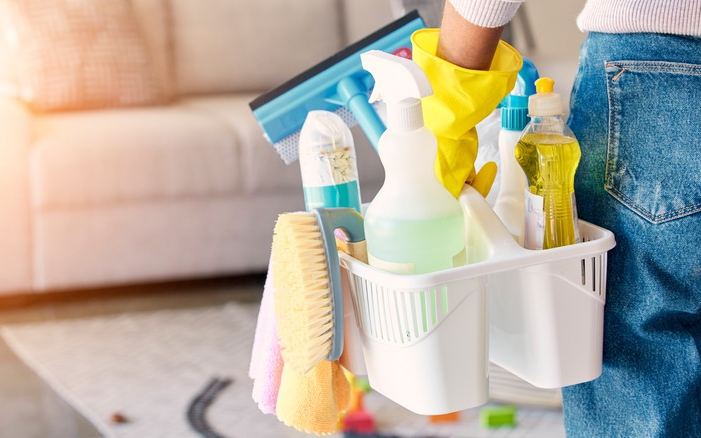
Everything above plus the four skipped categories. In practice that means a different toolkit — ladders, detail brushes, a degreaser with real dwell time, an acidic cleaner for mineral scale — and a different pace.
- Inside the oven, the refrigerator and the dishwasher filter
- Grout brushed and rinsed on both floors and shower walls
- Cabinet interiors emptied, cleaned and dried
- Baseboards washed rather than dusted, plus door frames and window tracks
- Ceiling fan blades, light fixtures, exhaust fan covers and vent registers
- Behind and beneath every appliance and piece of furniture that moves safely
One caution worth knowing before you book: some things a deep clean cannot fix. Grout that has lost its seal stays discoloured because the soil is inside the material. Caulk with mould beneath the surface has to be cut out and replaced. Any company promising a like-new result on failed materials is selling you disappointment.
How long each one takes
Time is the most reliable way to compare quotes, because it is the one number that cannot be redefined. Ask any company how many labour hours the job is and how many people are coming. Two numbers, and the whole picture becomes clear.
As a rough guide for a three-bedroom, two-bathroom home: a maintenance visit runs three to four labour hours. A first-time or deep clean on the same property runs eight to twelve. If a company quotes a deep clean at five hours for that house, they have quietly redefined the term.
Using both together
The most economical pattern is not choosing between them — it is sequencing them. One deep clean establishes a level baseline, and then recurring maintenance visits hold it there. Because the accumulated layer is gone, each maintenance visit accomplishes more in the same time, and you never return to needing another restoration.
Households that skip the initial reset and go straight to biweekly service usually feel like the results plateau below what they hoped for. That is not the crew underperforming. It is three hours a visit spent partly fighting build-up that should have been removed once, properly, at the start.
The other pattern worth knowing: one deep clean a year, scheduled either before the holidays or at the start of spring, layered on top of an existing recurring plan. It catches the rotating items — window tracks, vents, cabinet interiors — that even a good biweekly rhythm cannot fully cover.
Common questions
Often yes, because the categories a deep clean covers are exactly the ones weekly self-cleaning skips — ladder-height fixtures, behind appliances, inside cabinets and grout lines. Weekly effort keeps the visible surfaces excellent while those four categories quietly accumulate.
Yes, and kitchens and bathrooms are the two most commonly requested on their own. It is a sensible way to spread the cost — deep clean the bathroom this quarter and the kitchen next, rather than doing the whole house at once.
Once a year is a reasonable default for a home on a recurring maintenance plan. Homes without regular service, or with pets, smokers or heavy cooking, benefit from twice a year.